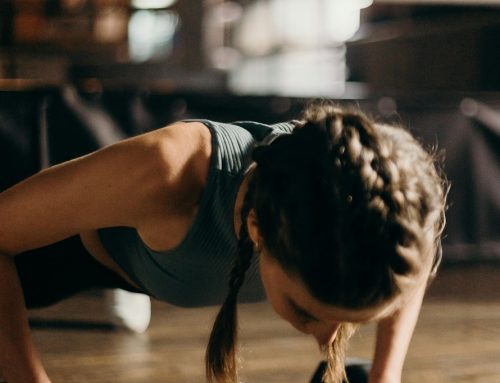
The planche is one of the most impressive calisthenics skills anyone can perform. Holding your entire body parallel to the ground with just your arms to support you looks cool and is incredibly difficult. If you’ve been grinding away at planche training and feel like you’re getting nowhere, you’re not alone. Many athletes hit a plateau with this skill. Even for the most consistent and dedicated athletes, planche can make them feel like their training is pointless. Here are five common reasons why your planche progress might be stuck and how to break through planche plateaus.
1. You Skipped The Early Planche Progressions

The planche isn’t a skill that you can gain overnight with no practice. It requires a smart, progressive, and specific approach. If you’re jumping from tuck planche to full planche without mastering intermediate progressions like advanced tuck, straddle, or band-assisted variations, you’re setting yourself up for frustration. Very few people ever get the full planche without ever doing any variations or band work. Each progression builds the specific strength, technique, and joint conditioning you need to go further. Stick with a progression until it becomes solid before moving on.
Once you can hold a progression with good form for 10 seconds, then you can consider moving on to the next progression with an assistance band that lets you hold that variation for 10 seconds.
Once your banded holds reach 15 seconds, use a progressively lighter band until you are able to hold the planche variation without a band for 10 seconds. This is one of the best ways to progressively overload your planche training while staying specific to the skill.
2. You Have Never Trained For Scapular Protraction
Performing the planche isn’t just about training your joints or being strong at push exercises. When learning the planche or other push skills from influencers or other calisthenics websites, you will often hear about scapular protraction. To put it simply, scapular protraction is extending your shoulders (front delts), to be in front of your chest. At full protraction, this extends the lever by raising your center of mass – making the planche much easier.
This is much easier said than done. Often during planche training a persons scapula lose that protraction and they will sink into retraction or a neutral position. This not only increases the load on your shoulders to hold the body parallel to the floor but also makes it much harder to balance.
To strengthen your scapula for the planche we recommend doing elevated, band-assisted, psuedo planche pushups. If you’ve never done these before, they are a great way to practice pushing from your waist line without fully loading your shoulders. As you progress you can either reduce the assistance from the band or decrease the elevation. Every rep of these pushups should aim to lockout your arms and push your shoulders downward into the floor.
For extra focus on your scapula, lockout the top position and hold it for 3 seconds between each rep. You can also take it a step further with gymnastics rings.
3. You Don’t Prioritize Recovery
We don’t get stronger during our training. We get stronger during recovery. This statement is true whether you are focused on calisthenics skills like the planche or hypertrophy muscle building. Training triggers the need for adaptation, but it is not when the adaptation begins.
Think of training like a seed. It needs to be fertilized to know that it needs to grow and it needs food and sunlight to actually grow. The same applies to calithenics athletes, we need to rest and recover to make progress.
Too many athletes hammer out planche work every day without enough rest, leading to CNS fatigue, joint pain, or even injury. The planche is highly demanding on the wrists, elbows, and shoulders. If you’re always sore, shaking, or losing form, scale back and take a rest day or 2.
For most people, planche should not be trained more than 3 times per week. Any more than that puts a significant load on your joints, which take longer than muscles to adapt to.
4. You Don’t Use Bands Or Use Too Heavy Bands
Not to double back to reason number 1 but for those stuck in the more advanced planche progressions like the straddle planche or full planche, using bands can be the biggest difference maker in your progress. Bands allow you to get into the full planche position without the prerequisite strength or conditioning. It speeds up your nervous systems ability to understand the body position and activate the right muscles while being at a lower intensity.
Planche is a complex movement to hold that requires tensing so many different muscle groups at once. For many calisthenics athletes, lifting their legs during the planche is incredibly hard. Many even begin to doubt their minds and think their genetics aren’t made for planche. This couldn’t be farther from the truth.
The truth is that their CNS, central nervous system, isn’t used to activating all of the muscles used in a full planche at the same time. Hoping into a full planche or straddle planche before having it mastered can usually lead to bad form where the legs or lower back are sinking /piking. Bands allow you to get the feeling of holding a full planche with a set amount of weight removed from your center of mass.
However, using resistance bands to learn the planche can be a double edged sword. Using a band that provides too much assistance will create imbalances in your core and lower body due to the bands placement. This can make progress feel very slow and often difficult to measure due to an over reliance on bands. For the full planche, you should never be using a band that is removing more than 50% of your total bodyweight. This is far too much assistance. In these cases revert back to an easier planche progression and continue using the band there.
5. Your Mindset Isn’t There
This happens to even the best calisthenics athletes. Mindset is one of the biggest factors when breaking through planche plateaus or learning any skill. Especially with more difficult skills like the planche or front lever. Many times intermediate calisthenics athletes that are stuck on the planche get the idea in their head that they are too tall for calisthenics, have bad genetics, or any other excuse why they are not able to planche. Some even turn to the mathematical approach trying to figure out leverages and torque only to be stuck at their current progression level for months or even years.
We’ve been that athlete and have coached many of them.
The planche is a hard skill but it is far from impossible or limited to the genetic elites. If you have built up the prerequisite strength, gone through and mastered the progressions, and are lean enough, the planche is a skill that we believe anyone can unlock. For some it might take a few months for others it could take several years. Specificity and consistency is the key to unlocking skills. Remove the doubts in your mind about not being built to planche – in the 1900s there were 250lb+ bodybuilders that were performing the full planche and other skills. This was a time long before anabolics and custom training plans. If they can do it, so can you!
To learn more about planche and calisthenics skill training, check out our blog.