Ever had a week where your pull-ups feel twice as heavy, your handstand balance disappears, and your planche progression suddenly feels like you’ve teleported back two months? You’re training hard, eating well, doing everything “right”—yet somehow you’re moving backward.
Sounds familiar? You’re not alone. In calisthenics, this happens to everyone, and most people misinterpret it as weakness, poor programming, or lack of discipline. But the real culprit usually isn’t any of that. It’s fatigue slowly building up in your muscles, joints, and nervous system.
That’s where deloads come in. A deload isn’t about slacking off or losing progress. It’s a strategic tool that helps your body reset, recover, and come back stronger than before. In fact, if you’re skipping deloads, you might be holding your own gains back without realizing it.
Let’s dive into why deloads matter so much in calisthenics, how they prevent plateaus and injuries, and how to use them to level up your strength and skills.
What Is a Deload In Workouts & Calisthenics?
A deload is basically a short, planned break in your training where you intentionally reduce how hard you’re working. You’re not stopping completely, and you’re not being lazy—it’s more like letting your body catch its breath after weeks of hard work.
Think of it like giving your system a tune-up. If you drove your car nonstop without ever slowing down or doing maintenance, eventually something would break. Your body’s the same way. A deload is that maintenance period that keeps everything functioning smoothly.
Most deloads last around 3–7 days, and the point is simple: reduce training stress so your body can recover and super-compensate. When you come back, you’re stronger.
Why Calisthenics Needs More Frequent Deloads
This is the part most people miss. If you lift weights, your muscles get tired, but barbells and machines distribute load predictably. In calisthenics, you are the equipment—and your joints, tendons, and nervous system often take the brunt of the load. There is no DOMs in your tendons, you won’t feel when they need to recover until it is too late.
Here’s why deloads matter so much for calisthenics athletes, especially if they train on gymnastics rings:
1. Your Joints and Tendons Need More Recovery Time
Calisthenics movements like the push-up, dips, handstands, levers, planches put a ton of stress on certain areas:
- wrists
- elbows
- shoulders
- scapular stabilizers
The tricky part? Connective tissues and tendons heal slower than muscles. So while your muscles might feel completely fine, deep down your tendons could be screaming for a break. Ignoring this is the fastest way to end up with:
- wrist pain
- elbow tendinopathy
- shoulder irritation
- rotator cuff flare-ups
A deload gives these areas a chance to catch up before problems start. While on your deload, don’t forget to continue taking collagen supplements.
2. Skill Progression Depends on Neural Freshness
Calisthenics skill training is extremely technical. A good planche or lever isn’t just “strength”—it’s coordination, balance, and body control. These skills depend heavily on your central nervous system (CNS) being sharp.
When you’re over-fatigued:
- form gets sloppy
- balance feels off
- progress stalls
- everything feels heavier
A deload helps your nervous system reset so your skills feel smooth again. Remember that strength comes from your nervous system, not your muscles.
3. Taking Deloads Help Break Plateaus In Training
A lot of people think they’re stuck because their program isn’t good or they’re not strong enough yet. But in reality, most plateaus happen simply because you’re carrying too much accumulated fatigue.
Once you reduce the stress for a week, your performance “rebounds.” Suddenly, the move that felt impossible two weeks ago feels light.
4. Injury Prevention Is Everything in Calisthenics
You can technically train through muscle soreness. You cannot train through irritated connective tissues.
Overuse injuries are sneaky—they creep in slowly, and by the time you feel pain, the damage is already done. That’s why high-level calisthenics athletes deload regularly, even when everything feels fine.
5. Deloads Reduce Burnout and Keep Training Fun
Heavy skill work isn’t just physically taxing, it’s also mentally draining. Stalling in your progress for months can be demotivating. A deload gives you a chance to shift gears and enjoy lighter training, mobility work, or easy drills. You come back hungrier and more motivated.
How to Actually Take a Deload (Without Feeling Like You’re Wasting a Week)
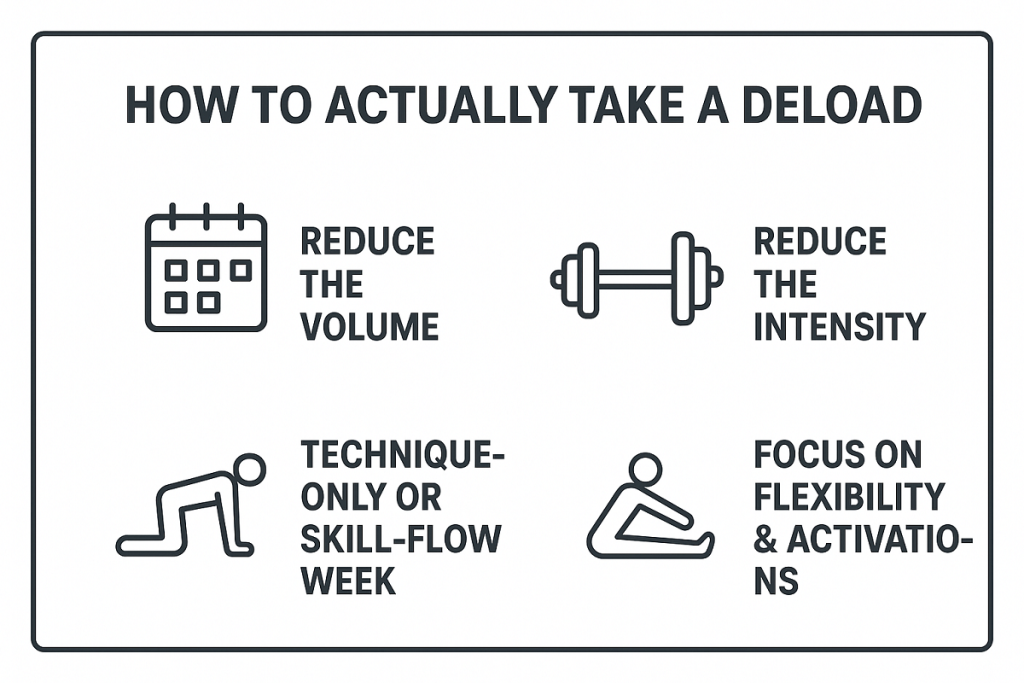
A deload isn’t sitting on the couch doing nothing. The goal is to move, practice, and stay active—but at a lower stress level. There are three main ways to do it:
Option 1: Reduce the Volume
You keep the same exercises, but you cut your sets, reps, or both by 40–80%.
For example:
- If you normally do 5 sets of pull-ups, do 1–2.
- If you do 10 handstand push ups a day, do 2-6.
- If your push-up routine is 4 sets of 20, do 2 sets of 10–15.
This is the easiest type of deload and works great if your joints feel fine, but you’re generally fatigued.
Option 2: Reduce the Intensity
This means doing easier progressions of the same skills.
Examples:
- tuck planche instead of advanced tuck
- ring rows instead of pull-ups
- pike push-ups instead of handstand push-ups
- bodyweight dips instead of weighted dips
If your joints feel irritated, this is the best approach because it reduces stress on connective tissues while still letting you practice the movement patterns. Total volume should also be lowered, you should never be training to failure.
Option 3: Technique-Only or Skill-Flow Week
This is a fun one, it is also our favorite way to do a delaod. You basically turn your week into a “light practice” week. No grinding, no max attempts, nothing near failure.
You can work on:
- light handstand balance drills
- scapular mobility
- hollow body work
- easy core drills
- flexibility
- cleaner movement patterns
This leaves you feeling refreshed, not exhausted. Think of doing conditioning or activation exercises like planks with protraction, hall-assisted handstands, and scapular pushups.
How Often Should You Deload?
This depends on your training intensity, your goals, and your recovery habits. But here are solid guidelines:
- Every 8-12 weeks for most people
- Every 6–8 weeks if you’re doing heavy weighted calisthenics or hard skill progressions
- Every 10-12 weeks if your training is light or moderate focused more on building endurance or hypertrophy.
You may also need a deload sooner if:
- your joints start feeling “tweaky”
- your grip strength drops drastically
- skills suddenly feel harder
- you feel unmotivated
- your sleep or mood gets worse
- you’re plateaued for 2+ weeks
Your body will usually give you the signs—you just have to listen.
What a Calisthenics Deload Week Looks Like When Training Skills
Stick to progressions that feel easy and clean. No max attempts, no grinding, and no long sessions. Focus on quality and getting the right activation, not intensity. This can be making sure to do planche leans with PPT instead of straddle planche holds, or retracting on bodyweight rows instead of front lever pull ups.
The Real Benefits You’ll Notice After a Deload
Most people are shocked by how different they feel after just 5–7 days of reduced training stress. Here are the most common results:
- your joints feel smoother
- motivation skyrockets
- strength jumps up
- planche/lever progresses faster
- handstands feel more controlled
- you recover faster after normal sessions
- overall training quality improves
Think of deloads as part of the process, not a break from progress. They are a strategic way to make progress faster and safer.
Final Thoughts On Deloads In Calisthenics Training
Calisthenics rewards consistency, smart training, and body awareness. Deloads might feel counterintuitive at first—especially if you’re used to grinding constantly but once you incorporate them, you’ll notice your gains feel smoother, your joints feel happier, and your skills develop faster.
If you’re serious about planche, levers, handstands, or even basic strength, deloads aren’t optional. They’re one of the most effective tools you can use to keep progressing long-term. To learn more about deloads and bodyweight training, check out our calisthenics blog.