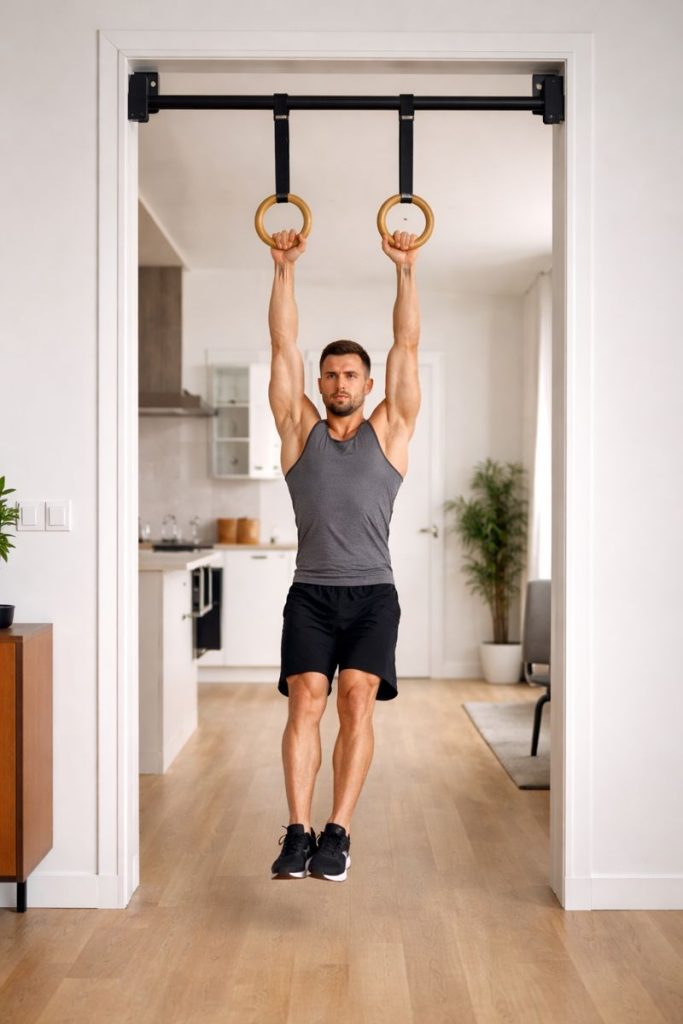
Yes! Gymnastics rings can be hung on any pullup bar. However, for safety, make sure that the pullup bar is properly secured to the wall, doorframe, cieling, or support beams. A loose bar can collapse under the weight of your body when factoring in the instability from gymnastics rings.
This article will cover everything you need to know about setting up rings on a pull-up bar, why you should do it immediately, and how to stay safe while doing so.
Safety When Using Gymnastics Rings On A Pull Up Bar
Before you sling your rings over your pullup bar, we need to talk about your anchor point. Not all pull-up bars are created equal. Here is what you need to know about each type of pullupbar and how it can affect your gymnastics rings.
1. Doorway Pull-Up Bars (Cantilever/Leverage Style)
These are the bars that hook onto the top of the doorframe and use your body weight to lever themselves against the wall.
- Verdict: Use with Caution.
- The Risk: These bars rely on downward force to stay secure. When you use rings, you are often moving your body center of mass away from directly underneath the bar (e.g., during ring rows or skin-the-cats). This changes the angle of pull. If you pull too much horizontally, you risk unhooking the bar from the doorframe.
- The Fix: If you use this type of bar, stick to exercises where your weight remains mostly vertical (pull-ups, knee raises). Avoid swinging or horizontal pulling motions unless you are extremely controlled. As an added safety measure, if possible screw these types of pull-up bars into the doorframe.
2. Tension Bars (Twist-to-Tighten)
These bars rely on friction against the inside of the doorframe.
- Verdict: Generally Avoid.
- The Risk: The instability of rings causes them to rotate and swing. This vibration and rotation can slowly loosen the tension of the bar. A sudden failure here can lead to inury.
- The Fix: Unless it has heavy-duty screwed-in safety cups, do not use rings on a tension bar. These are the worst type of pullup bar and we recommend avoiding them entirely.
3. Wall/Ceiling Mounted or Power Tower Bars
These are bolted into studs or are part of a heavy freestanding unit.
- Verdict: Perfect.
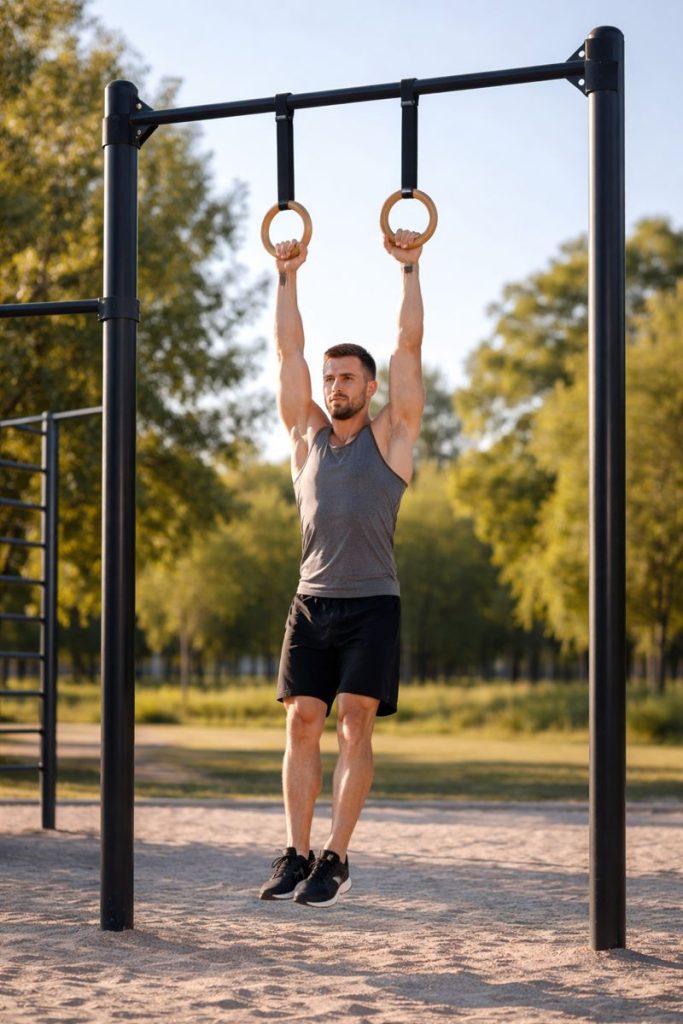
- The Why: These are solid points of stability. You can pull from any angle—horizontal rows, front levers, dips—without worrying about the bar detaching. These can often even support weighted pullups and heavier loads.
Why You Should Switch to Gymnastics Rings (Even if You Have a Bar)
If you already have a pull-up bar, why bother adding rings? Isn’t a pull-up just a pull-up?
Absolutely not. Transitioning to gymnastics rings changes the fundamental mechanics of every exercise.
1. The Stability Factor (Proprioception)
A pull-up bar is stable. It doesn’t move. When you exert force, 100% of that force goes into the movement. Rings are unstable. They are free-moving in 360 degrees. When you jump up to a support hold on rings, your body has to fight just to stop the rings from shaking. This recruits countless stabilizer muscles in your shoulders, chest, and core that lay dormant during bar work. This is why a guy who can bench press 300lbs might shake uncontrollably trying to hold himself up on rings. It also emphasizes grip strength much more.
2. Joint Health and Longevity
This is the biggest selling point for older athletes or anyone with nagging injuries or relying on deloads. On a straight bar, your hands are locked in a fixed position (usually pronated or supinated). As you pull, your elbows and shoulders are forced to accommodate this fixed hand position, which can lead to impingement or tendonitis (like golfer’s elbow). Rings rotate freely. As you perform a pull-up, your hands can naturally rotate from pronated (palms away) at the bottom to neutral (palms facing) or supinated (palms facing you) at the top. This allows your joints and tendons to track in their most natural, pain-free path.
3. Infinite Scalability
To make a push-up harder on the floor, you pretty much have to add weight. On rings, you just change the angle.
- Too hard? Walk your feet forward so you are more upright.
- Too easy? Walk your feet back until you are parallel to the ground.
- Still too easy? Elevate your feet on a box. You can adjust the difficulty of every exercise in seconds without changing weights.
Step-by-Step Setup Guide For Using Gymnastics Rings On A Pullup Bar
Getting the rings out of the box is exciting, but the straps can be confusing. Here is how to set them up correctly on your bar to ensure you don’t slip mid-set.
- The Over-Under Method: Throw the metal cam buckle over the pull-up bar.
- Thread the Strap: Take the other end of the strap and feed it through the ring itself.
- the Buckle Entry: This is where most people mess up. You must feed the strap into the cam buckle from the back (the side where the teeth clamp down). If you feed it from the wrong direction, the strap will just slide right out when you apply weight.
- Safety Test: Before trusting your weight to it, pull down hard on the ring. If it slips, re-thread the buckle.
- Excess Strap Management: You will likely have several feet of extra strap dangling. Do not just let it hang; it can get caught in your feet or distract you. Tie a simple slip knot or use velcro ties to bundle it up near the cam buckle.
Learn More About Where To Setup Your Gymnastics Rings
Can you use gymnastics rings on a pull-up bar? Yes, and you should. It is the cheapest, most effective upgrade you can make to your home gym. For an investment of around $50, you unlock a new way of training that builds functional strength, bulletproofs your joints, and challenges your body in ways a static bar never could.
To learn more about gymnastics rings, checkout our blog. You can also buy premium gymnastics rings from our store.